Why It Matters
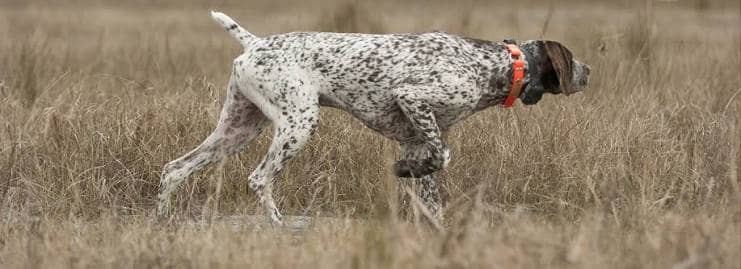
A point is a GSP's instinctive response to game scent — movement stops and the dog indicates where the quarry is. It's one of the breed's defining working behaviours, and it's inherited, not taught from scratch.
New handlers often expect a single 'textbook' posture. In reality, intensity, body posture and how a dog holds a point vary considerably from dog to dog, scent distance to scent distance.
The Principle
Bird contact should build confidence, not fear.
How To Do It
- Recognise that a lifted foreleg is not mandatory for a genuine point — posture varies, and intensity is a better indicator than a specific stance.
- Watch for the point developing at increasing scent distances as the dog gains experience.
- Manage 'creeping' (inching toward the bird instead of holding) with calm, consistent handling rather than sharp correction.
- Approach a pointing dog calmly and predictably — sudden or rough handling near a hold can damage confidence built over months.
- Give a young dog time to develop this naturally rather than forcing early formal steadiness before the instinct is established.
Common Mistakes
- Expecting a single correct 'stance' and treating natural variation as a fault.
- Correcting hard around birds when a dog creeps, instead of managing it calmly.
- Rushing to formal steadiness work before the dog is confidently and consistently pointing.
- Approaching a hold abruptly, which can startle or unsettle a young dog.
When To Move On
Once your dog is holding points with growing consistency and confidence, you can begin Steadiness work — and it's worth protecting the instinct deliberately (see Protect the Pointing Instinct) as you do.
Record This In HOUND
Event: Natural Ability / field session · Score · Judge notes · Certificate
Formal Natural Ability results and informal field observations both belong in your GSP's Field + Performance phase.